
Teaching exponent rules can feel overwhelming at first, but guiding students through the rules step by step makes the process much easier. Instead of simply handing them rules to memorize, showing how each rule is derived helps students truly understand the concept. By exploring patterns when writing problems in expanded form and giving students the chance to discover the rules on their own, you’ll make exponent laws more meaningful and memorable. This approach not only strengthens their understanding but also gives them strategies to figure out a rule if they forget it later.
Helping Students Discover the Product Rule of Exponents
Start with the Product Rule of Exponents. This exponent rule explains that when you multiply numbers (or variables) with the same base, you keep the base and simply add the exponents. Instead of giving students the rule right away, guide them to discover it on their own.
Start by writing an example of a problem in expanded form. For example: Write (x4)(x2) in expanded form. Walk students through what x4 means—(x×x×x×x)and what x2 means. When combined, they should notice that there are six x’s being multiplied, or x6. After practicing several problems this way, discuss how writing everything in expanded form takes time. This leads naturally to the rule: adding the exponents when multiplying powers with the same base.

Discovering the Quotient Rule of Exponents
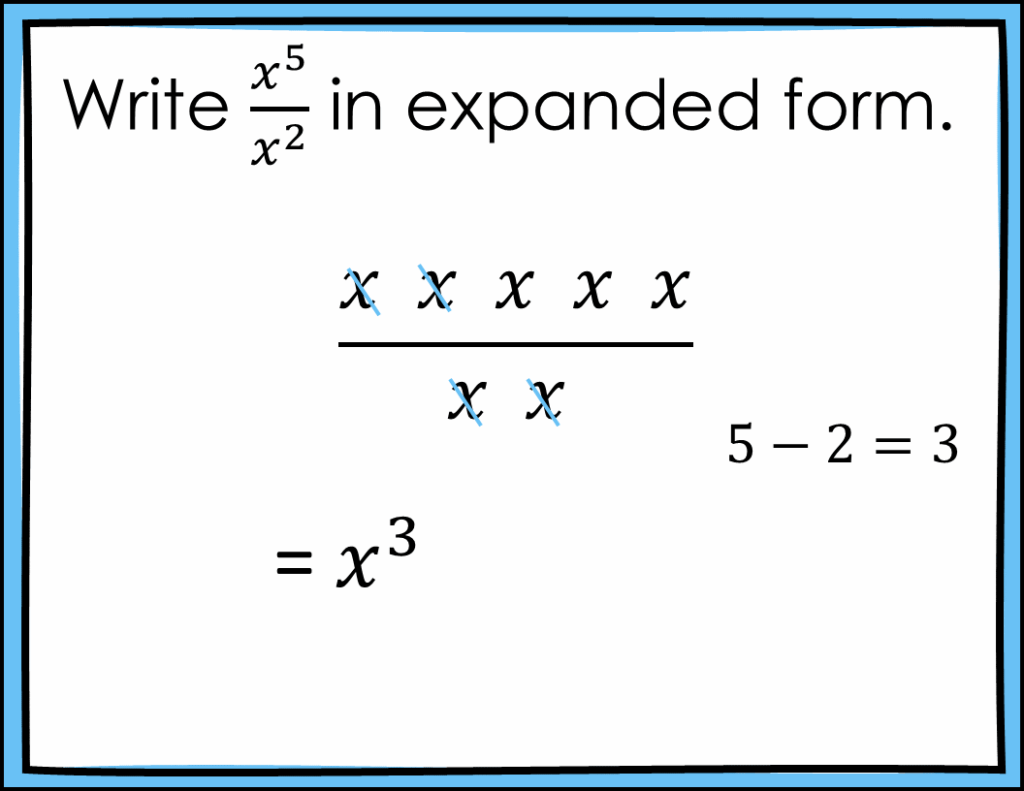
Next, introduce the Quotient Rule of Exponents. This exponent rule states that when dividing two expressions with the same base, you keep the base and subtract the exponents (top minus bottom). To help students discover this, start by writing an example such as x^5/x^2 in expanded form. Guide them through writing out each part, then remind them that any number or variable divided by itself equals 1.
Give students time to practice several problems in expanded form so they can see the pattern for themselves. From there, highlight how this rule works as the opposite of the Product Rule, which makes it easier for them to remember.
Understanding the Power to a Power Exponent Rule
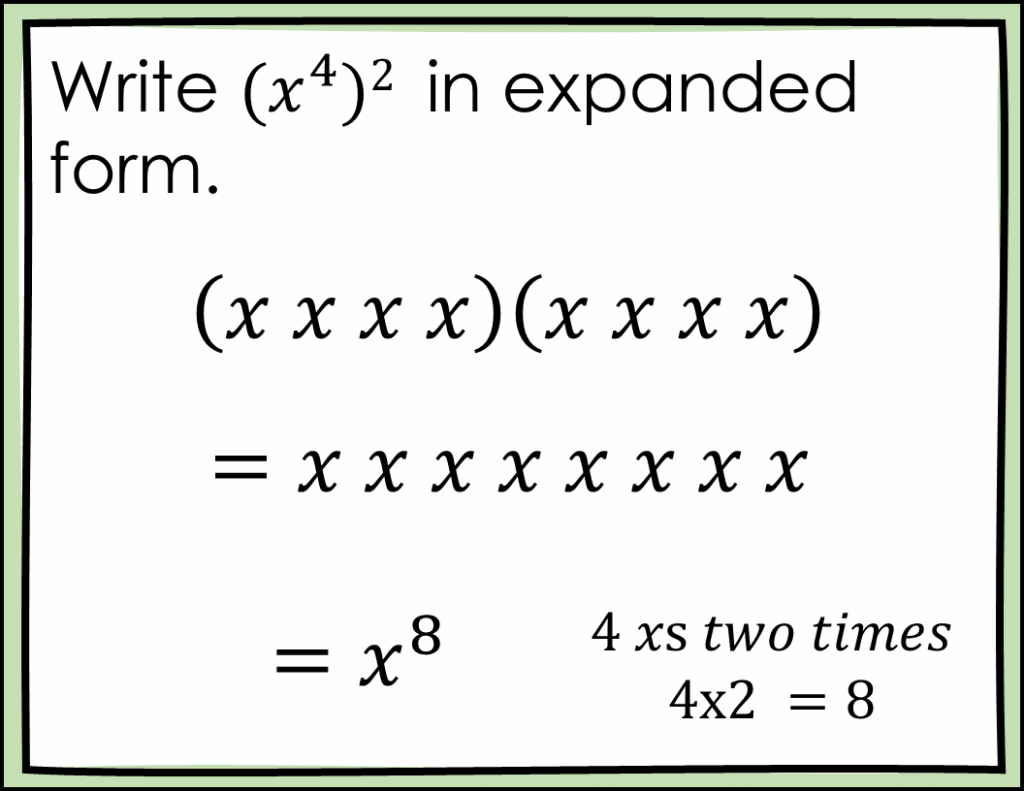
The final rule to introduce is the Power to a Power Rule. This rule states that when an exponent is raised to another exponent, you multiply the exponents while keeping the base the same. For example, (x4)2 can be written in expanded form to show that you have four x’s, repeated twice. This helps students clearly see why multiplying the exponents gives the correct answer.
Exploring Negative and Zero Exponents
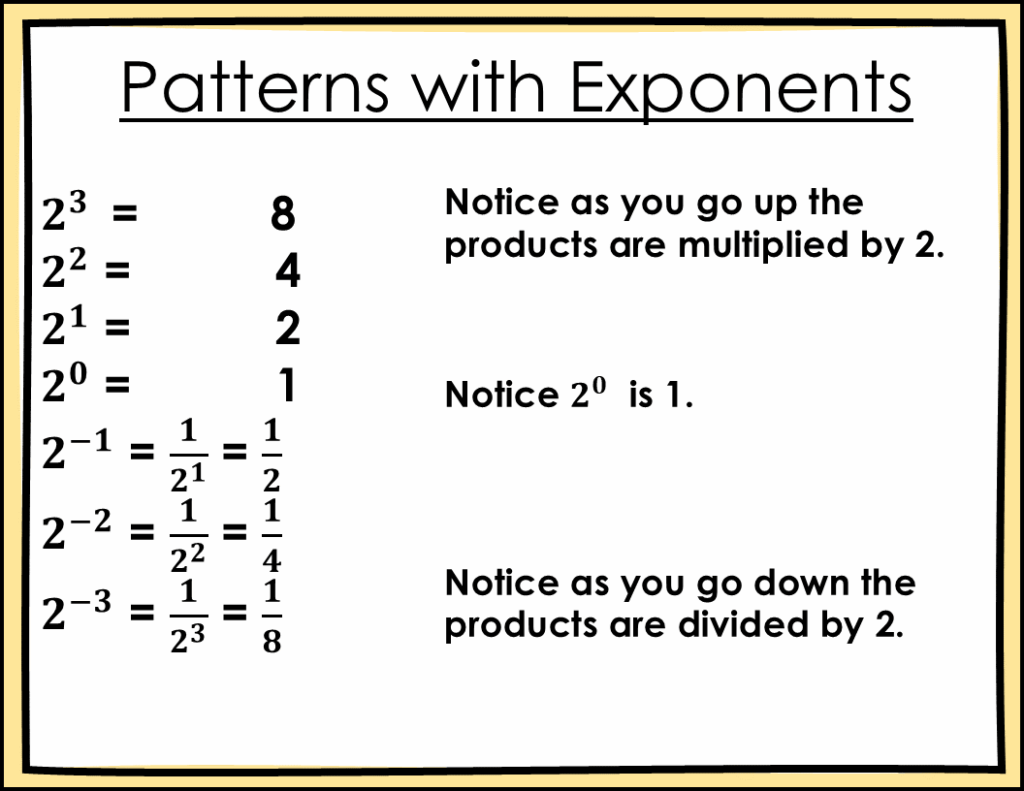
Use patterns in exponents to help students make sense of negative and zero exponents. By exploring how exponents decrease, students can see that each step involves dividing by the base, which naturally leads to the idea of negative exponents. Extend the pattern with different bases, and students will discover an important rule: any base raised to the zero power always equals 1.
Conclusion
Mastering the exponent rules is an important step in building a solid foundation for algebra and beyond. By guiding students to discover the Product Rule, Quotient Rule, Power to a Power Rule, and the patterns behind negative and zero exponents, you help them move beyond memorization to true understanding. When students see how the exponent rules are created and practice applying them, they gain the confidence to tackle more complex problems with ease.
Need help teaching exponent rules? Check out our Exponent Rules and Scientific Notation Unit. The unit has 10 lessons, a test review game, and a test. All of the lessons include an editable PowerPoint, guided notes, an activity and a practice sheet. Google links for the lesson are also included. You can also get a free sample of from one of our 8th Grade Lessons. Links are below for the Exponent and Scientific Notation Unit and the Free Dilations Lesson.