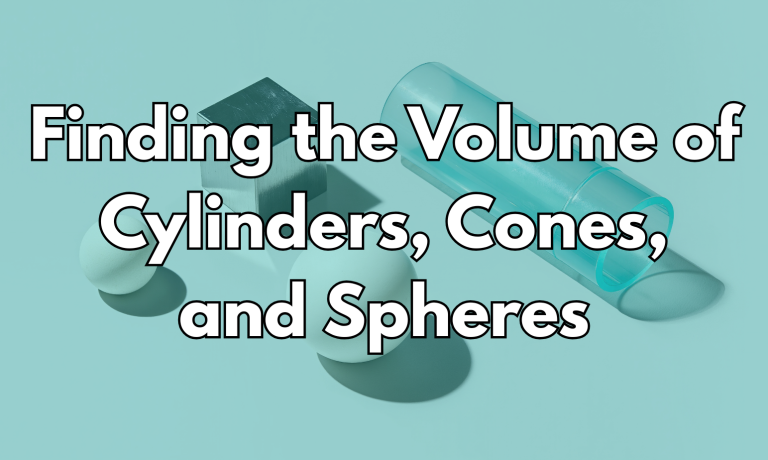
Understanding how to find the volume of three-dimensional figures like cylinders, cones, and spheres is an important part of middle school math. Cylinders, cones, and spheres appear in everyday objects like cans, ice cream cones, and balls, which makes these shapes perfect for connecting math to real life. In this post, we’ll walk through how to teach students to find the volume of cylinders, cones, and spheres, identify their parts, and explore how these figures are related.
Finding the Volume of Cylinders
A cylinder is a 3D shape with two circles (one on top and one on bottom) and one curved side. Both circles are the same size. Common examples include soup cans and paper towel rolls.
Parts of a Cylinder
Before using the formula, students should be able to identify:
Radius (r): the distance from the center of the circular base to its edge
Diameter: twice the radius
Height (h): the distance between the two circular bases
Base: the circular face of the cylinder
Using the volume formula for cylinders becomes much easier once you understand how to identify each part. To find the volume, use the formula V = πr²h. Start with π (pi). Since pi is an irrational number, you will need to use an approximation such as 3.14 or 22/7, which are the most commonly used values. If your calculator has a π button, you can use that for a more accurate result. Next, multiply π by the radius squared. Be sure to look at the circular base to determine whether you were given the radius or the diameter. If the diameter is provided, divide it by 2 to find the radius. Finally, multiply π and the radius squared by the height of the cylinder to find the volume. This formula works because you are finding the area of the base (πr²) and then multiplying by the height to see how many layers of that base fit inside the cylinder.
Finding the Volume of Cones
A cone has one circular base and tapers to a point called the vertex. Ice cream cones and party hats are great real-life examples.
Parts of a Cone
Students should identify:
Radius (r): the distance from the center of the circular base to its edge
Height (h): the perpendicular distance from the base to the vertex
Base: the circular bottom
Vertex: the pointed top
The volume of a cone is found using the formula V = ⅓πr²h. Begin by identifying the parts you need, just like you did when finding the volume of a cylinder: π, the radius, and the height. Multiply pi by the radius squared (r^2), then multiply by the height. Finally, multiply your result by 1/3 (or divide by 3) to find the volume of the cone.
This formula looks very similar to the cylinder volume formula, but it includes ⅓. That fraction is important because a cone holds only one-third the volume of a cylinder with the same radius and height. In fact, it would take three identical cones to completely fill one matching cylinder.
Finding the Volume of Spheres
A sphere is a perfectly round 3D shape, like a basketball or globe.
Parts of a Sphere
The main measurement students need is:
Radius (r): the distance from the center of the sphere to its surface
Unlike cylinders and cones, spheres do not have a height.
The volume of a sphere is found using the formula V = ⁴⁄₃πr³. Just like with the other volume formulas, start by identifying the parts you need. For a sphere, you only need π (pi) and the radius. Begin by cubing the radius (r³), then multiply by π. Finally, multiply your result by ⁴⁄₃ to find the volume of the sphere.
The volume of a sphere is directly related to the volume of a cylinder. If you take a sphere with radius r and place it inside a cylinder that has the same radius r, and a height of 2r (the diameter of the sphere), then you see something interesting:
The sphere’s volume is two-thirds the volume of that cylinder.
Here’s why:
Volume of the cylinder: V = πr²(2r) = 2πr³
Volume of the sphere: V = ⁴⁄₃πr³
Now compare them: (4/3 πr^3)/(2πr^3 )=2/3
A sphere fills 2 out of every 3 parts of the matching cylinder.
So you can explain it to students like this:
If a sphere fits perfectly inside a cylinder with the same radius and a height equal to the sphere’s diameter, the sphere takes up two-thirds of the cylinder’s volume.
Conclusion
Learning how to find the volume of cylinders, cones, and spheres helps students build strong spatial reasoning and prepares them for more advanced geometry. By identifying each shape’s parts, practicing the formulas, and understanding how these figures relate to one another, students gain confidence and deeper understanding. With plenty of real-world examples volume can become an engaging and meaningful topic in your math classroom.
Check out these activities for finding volume of cylinders, cones, and spheres. We also have a unit to make teaching the volume of cylinders, cones, and spheres easy!
We use cookies to ensure that we give you the best experience on our website. If you continue to use this site we will assume that you are happy with it.